
How Much Does Wood Fence Installation Cost?
If you want a new wood fence, you probably have one big question: how much is it going to cost?
That’s fair. And a lot of contractors make this harder than it needs to be. You search online and find huge ranges with no real explanation.
In this guide, we give you real numbers. We explain what makes prices go up or down.
We tell you what a fair quote looks like. And we share what to watch out for before you sign anything.
Let’s get into it.
What Wood Fence Installation Costs
For most homeowners in the East Bay and Tri-Valley, wood fence installation costs between $40 and $75 per linear foot. That price includes materials and labor. It does not include gates.
Here are some real examples:
● 100 linear feet: $4,000 – $7,500
● 150 linear feet: $6,000 – $11,250
● 200 linear feet: $8,000 – $15,000
Where you land in that range depends on a few things. We cover each one below.
What Affects the Price?
1. Wood Type
Wood type is the biggest factor in material cost. Here are the most common options:
Redwood is the most popular choice in the Bay Area. It resists rot and insects on its own. It holds up well in our climate. And it looks great. It’s also the most expensive option. Materials usually run $30–$40 per linear foot.
Pressure-treated Douglas Fir is the most affordable wood. Materials cost about $10–$16 per linear foot. It’s treated to resist rot. But it doesn’t last as long as redwood or cedar — especially in areas with heavy sun or moisture.
At California Fences, we use the highest quality materials which lasts much longer. That’s why we can back it with a 15-year written guarantee.
2. Fence Height
A taller fence uses more material. More material means a higher price. Here’s the general breakdown:
● 5-foot fence: The lowest price range. Good for front yards or garden borders.
● 6-foot fence: The most common height. Standard for backyard privacy.
● 7-foot or taller: Adds cost. May need a permit depending on your city or HOA.
Most homeowners in Pleasanton, Dublin, and San Ramon go with a 6-foot fence. It gives you full privacy. And it usually doesn’t need a special permit.
3. Fence Style
The style you pick changes how much material and labor goes into the job.
Board-on-board/Louvered fence is the most popular style in the Tri-Valley. Boards overlap slightly. There are no gaps. You get full privacy and a clean look from both sides. It costs a bit more because of the extra boards. But it’s durable and looks great over time.
Nail On Fence is the most basic style. Boards sit side by side and overtime as the wood shrinks, it will develop small gaps. It’s faster to build and costs less. But you lose some privacy.
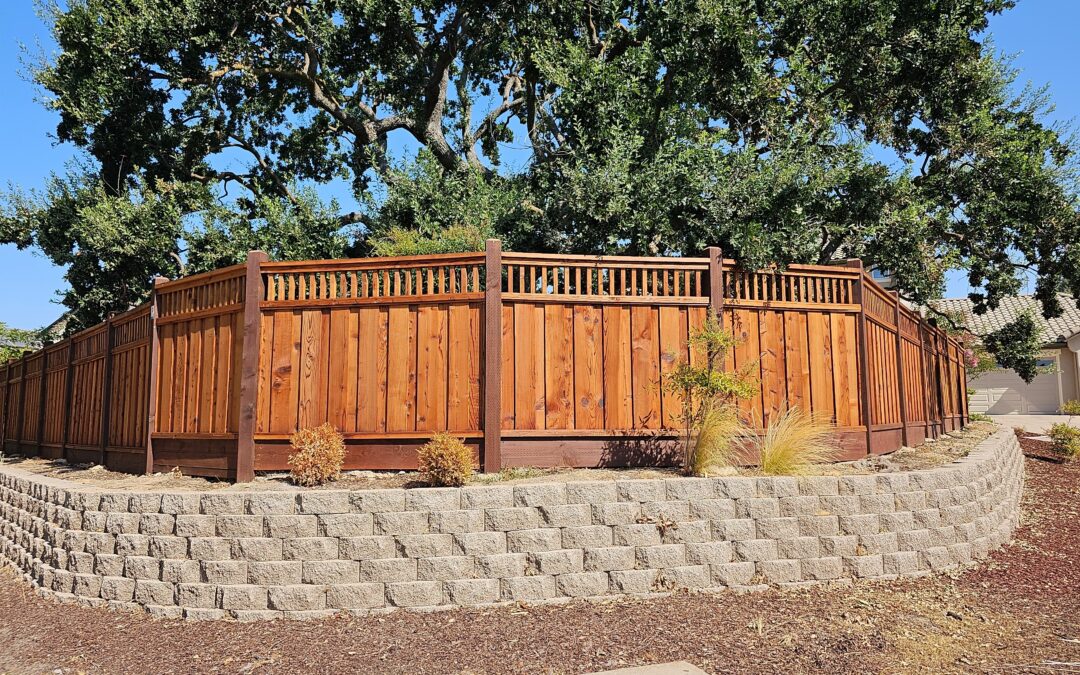
Lattice top adds a decorative lattice section above the solid boards. Usually this is an add-on and it gives a finished, custom look that many homeowners love.
Hogwire fence combines a wood frame with a wire mesh panel inset. It’s a modern, open look that’s popular with homeowners who want style without sacrificing airflow or sightlines. It works especially well in yards with gardens or views worth keeping. It tends to cost more than a standard wood fence because of the added materials and framing.
Deerwire fence is built for function. It uses a wood frame with a taller wire mesh — usually six feet or more — to keep deer and other wildlife out of your yard or garden. It’s a practical choice for properties near open space or hillside areas common in the Tri-Valley.
Horizontal fence uses boards that run side to side instead of up and down. It has a clean, modern look that’s become increasingly popular. It takes more skill to build correctly and requires quality lumber to avoid warping over time, so it typically costs more than a standard vertical fence.
4. Site Conditions
This is the part most contractors skip until after you’ve signed. That’s a problem. Here’s what can add to your cost:
Slopes and hills: If your yard isn’t flat, the fence has to follow the terrain. This takes more time and skill. That adds to the labor cost.
Concrete footings: Old concrete footings from a past fence may need to be removed. That adds time, materials, and cost.
Hard or rocky soil: Digging post holes in rocky or clay-heavy ground takes longer than in soft soil. This is common in parts of the Diablo foothills.
Tree roots: Roots near the fence line can block post placement. Moving around them takes extra time.
Sprinkler, Gas, and Electrical lines: Underground utilities and irrigation lines near the fence line need to be located and worked around carefully. Hitting a sprinkler line is a common and costly mistake. Gas and electrical lines require even more caution.
A good contractor will walk your yard before giving you a quote. They’ll spot these issues and include them in the price upfront. That’s the only way to avoid surprise costs later.
5. Gates
Gates are priced separately from the fence. Here’s what to expect:
● Walk gate (3–4 feet wide): $300 – $700 installed
● Wood double gate (8–12 feet wide): $700 – $1,500 installed
● Steel frame gate (8-12 feet wide): $2,000 – $5,000 installed
Gate pricing depends on width, hardware, and whether you want a lock or automatic
opener.
What a Good Quote Includes
When you get a quote for a wood fence, here’s what it should show:
● A fixed total price in writing — not a range
● Materials listed out with dimensions — wood type, grade, linear feet, post
spacing
● Labor included — not added later
● Old fence removal — clearly stated if it’s included or not
● Gate pricing — listed on its own if there are gates
● Payment terms — a normal deposit is 10% or $1,000 upfront, whichever is less
If a contractor gives you a vague quote and wants a big deposit before any work starts, that’s a warning sign. A good contractor puts everything in writing before you pay a thing.
At California Fences, every quote is written and itemized. And the price in that quote is the price you pay. We have a strict no change orders policy. If we missed something during the estimate, that’s on us — not on you.
Red Flags to Watch For
Here are warning signs when you’re getting fence quotes:
The price is way lower than everyone else. A quote that comes in 20-30% below the industry average usually means something is being cut. That might be cheaper materials, lower build quality, or key steps in the process. A cheap fence that fails in five years ends up costing more than a quality fence that lasts fifteen.
No written quote. If a contractor won’t put the scope and price in writing, don’t hire them.
A large deposit before work starts. More than 30% upfront is a red flag. It leaves you with little power if something goes wrong.
No license or insurance. In California, fence contractors must be licensed by the Contractors State License Board (CSLB). You can check any contractor’s license at cslb.ca.gov. Always ask for proof of insurance too.
No written guarantee. Most fence contractors offer a one-year warranty at best. If a contractor can’t tell you what they cover and for how long — in writing — take note of that.
How to Get the Best Value
Getting the best value is not the same as getting the lowest price. Here’s how to do it right:
Ask for a guarantee in writing. A contractor who offers a long written guarantee is confident in their work. That matters.
Ask if their installers are employees or subcontractors. A company that has their own employees usually have tighter control over the quality of their work. Companies that use subcontractors can’t train the subcontractors nor manage them as per the state EDD. So you will be subject to whatever that subcontractor’s quality standards are.
Think about total cost over time. A fence that lasts 15 years costs less than one that breaks down in 5-10 years. Repairs and early replacement add up fast.
Get a Free Estimate
At California Fences, we’ve been installing wood fences for 34 years. We serve Pleasanton, Dublin, San Ramon, Danville, Walnut Creek, Livermore, Concord, and Brentwood.
Every quote is written and itemized. The price we give you is the price you pay. No change orders. No surprises.
We back every fence with a 10-15 year written guarantee. And we guarantee installation within 30 days of signing.
We’d love to give you a free estimate. No pressure. No obligation. Just a clear, honest quote you can count on.
[Schedule Your Free Estimate →]
California Fences, Inc. — Pleasanton, CA. Licensed contractor #1099301. Serving the East Bay and Tri-Valley for 34 years.